Sections
- 3.1. Vectors and Linear Combinations
- 3.2. Norms
- 3.3. The Dot Product
- 3.4. Projecting onto a Single Vector
Summary
3.1 Vectors and Linear Combinations
A vector is an ordered list of real numbers.
A linear combination of is a vector of the form
for scalars .
3.2 Norms
The standard norm (also known as length or magnitude) is the norm:
Other norms:
norm: .
norm: .
norm: .
A unit vector has norm 1;
is the one in the direction of . “Norm” alone means .
3.3 The Dot Product
The dot product of two vectors and is a scalar. Two equivalent definitions:
Note that
and are orthogonal if
The dot product is commutative and distributive, and .
Expanding norms:
For norm proofs: square, convert to dot products, and expand. If : .
Cosine similarity:
(), between -1 (opposite) and 1 (same direction).
Cauchy-Schwarz:
with equality if and only if one vector is a multiple of the other.
3.4 Projecting onto a Single Vector
Approximation problem: which multiple () is closest to , i.e. minimizes ? The one whose error is orthogonal to , giving the orthogonal projection of onto :
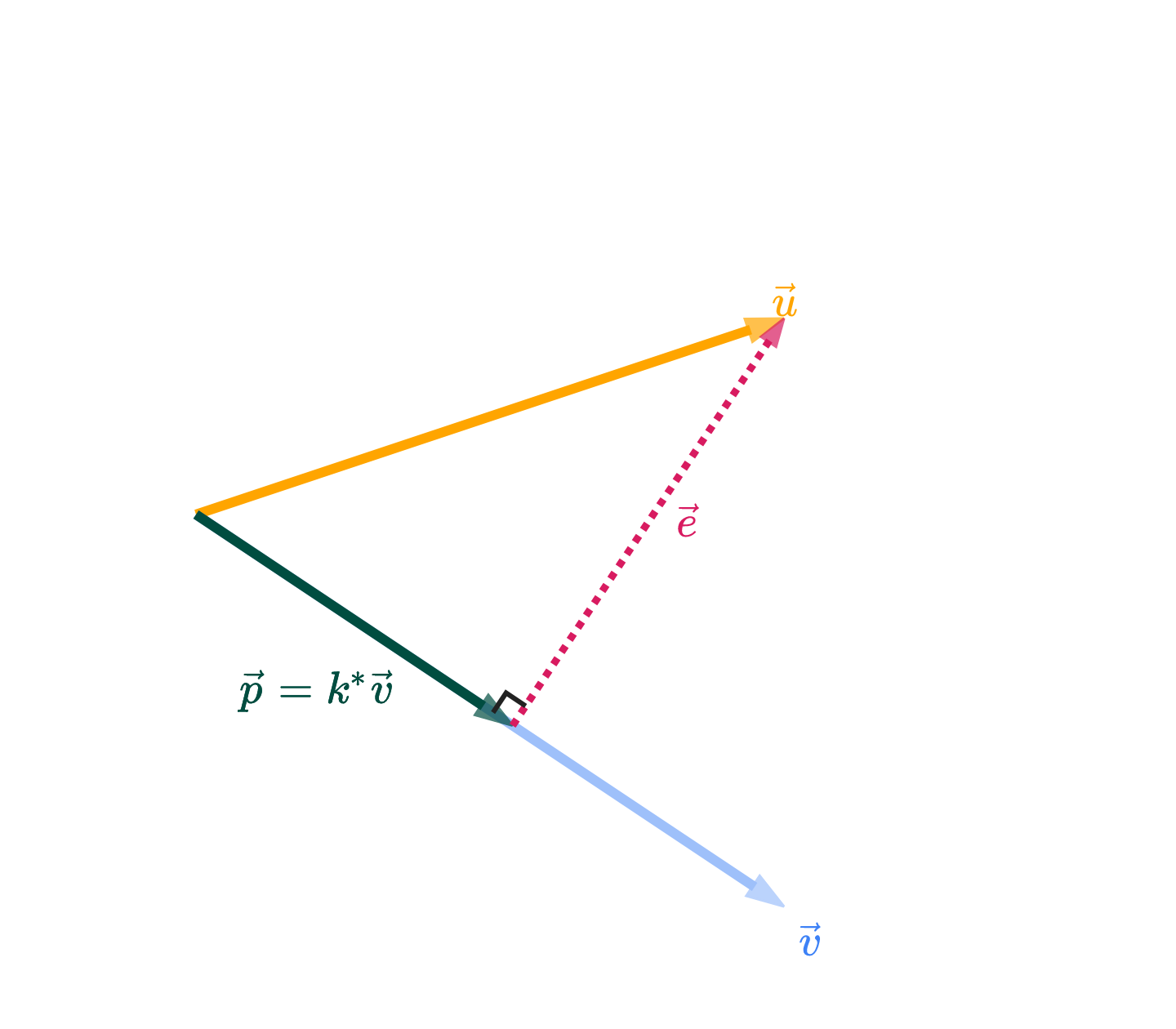
Projecting onto gives , where and are orthogonal.
Onto a unit vector :
Any nonzero multiple of gives the same . can be negative.
If are mutually orthogonal and is a linear combination of them (i.e. is in their span), the coefficients are
with no system to solve. Without orthogonality, this generally fails.